On a spring day with high grass pollen and a storm coming, the protection that counts happens at the window, not on the floor. Put the National Asthma Council's thunderstorm asthma advice beside the Australian Asthma Handbook's and you get four steps (our count across the two):
- Get inside before and during storms with wind gusts.
- Shut the windows.
- Switch the air conditioner to recirculate.
- Turn off any system that brings outdoor air in, such as an evaporative cooler.
All four keep outside air out. None of them is cleaning. The Handbook adds that these measures "may not completely prevent exposure".
That is the honest frame for this whole piece from Harbourfresh Carpet Cleaning. Looking after carpets and rugs is a year-round job about dust and dust mites. It is no shield against a storm. This is general information, not medical advice: your GP is the person to talk to about your own risk.
Why now? The National Asthma Council notes that "this year marks 10 years since the world's largest and most catastrophic epidemic thunderstorm asthma event in Melbourne on 21 November 2016". By the Council's account, ten people died and several thousand had breathing difficulties. That anniversary falls inside the grass pollen season, which "typically runs from the start of October until the end of December". That is about 92 days, our estimate from 31 + 30 + 31.
What happens in a thunderstorm asthma event
- Ryegrass heads release whole pollen grains into gusty wind ahead of a dark storm front
- Rain droplets hit the grains and break them into many tiny particles
- The particles are carried on the gust towards a house
- A split view of the house: an open window lets particles drift into the room; a shut window, a wall split-system on recirculate and an evaporative cooler switched off keep most particles outside
- Tiny particles reach deeper into the lungs than whole grains
Staying in with windows shut helps, but may not completely prevent exposure.
The trigger is pollen broken into pieces. Rain droplets break pollen grains into tiny particles that go deeper into the lungs.
The risk comes from being outside in gusty winds just before a storm on a high-pollen day, if you are allergic to ryegrass pollen. That is why every step above is about where you are and what air you breathe in those minutes.
A face mask “may help”. The Council is clear, though, that avoiding the outdoors just before a storm “is always safer”.
Who can be caught out, including people who have never had asthma
Adults aged 20 to 59 as a share of emergency department asthma admissions
You don't need an asthma diagnosis to be at risk: people with springtime hay fever can be affected even if they have never been told they have asthma. The highest-risk group is people with ryegrass-pollen allergy.
Melbourne in 2016 showed who gets caught. In the 30 hours of the event, adults aged 20 to 59 made up 57% of emergency department asthma admissions, against a usual average of 21%. That is about 2.7 times their usual share, our estimate from 57 ÷ 21.
About 1 in 5 Australians and New Zealanders have allergic rhinitis
Up to 4 out of 5 people with asthma also have allergies such as hay fever
Hay fever is common enough that this reaches into a lot of homes. About 1 in 5 Australians and New Zealanders have allergic rhinitis, and up to 4 out of 5 people with asthma also have allergies such as hay fever.
Some signs belong with a doctor rather than a tissue box. Breathlessness, wheezing and chest tightness "do not occur with hay fever alone", so book in with your GP if you notice them.
The Handbook also flags that people with grass-pollen allergy who self-manage with non-prescription salbutamol are at highest risk of severe attacks. If that sounds like you, take it to your GP.
If you have asthma, the Council asks you to update your written asthma action plan so you know what to do in a spring thunderstorm.
When the season runs, and what the record shows for NSW
Typical grass pollen seasonNational Asthma Council, ten years on
Several NSW events have occurred in OctoberAustralian Asthma Handbook
Melbourne's seven events, 1984 to 2016, were all in NovemberAustralian Asthma Handbook
Melbourne, 21 November 2016National Asthma Council, ten years on
Big events are rare, and NSW is not Melbourne. SafeWork NSW says events are infrequent and "don't happen every year". It records minor NSW events in the grass-pollen season in regions such as Wagga Wagga and northern NSW, and in the ACT.
Timing differs too. The Handbook notes that several NSW events have occurred in October, while Melbourne's seven events from 1984 to 2016 were all in November. So in NSW the risk window opens in October, with the start of the grass pollen season, not only in November.
The coast has some advantage. ASCIA says pollen counts are generally lower on the east coast, where most winds come from the sea. Even so, allergenic southern grasses mostly flower October to December. Warnings do reach this part of the state: in 2018 the Newcastle Herald reported NSW Health thunderstorm asthma warnings for the Hunter and north coast.
Storms are still on the cards this spring. AAMI's spring outlook, as reported by NC Times, expects a season “less active than normal”. It still expects severe thunderstorms, damaging winds, hail and heavy rain across NSW. Suncorp severe weather forecaster Justin Noonan puts it this way: “A quieter season does not mean a risk-free season.”
So the aim is to know the season, not to fear every cloud.
What to do at home on a spring storm day
When a storm with wind gusts is coming on a high-pollen spring day
Through the pollen season
These measures may not completely prevent exposure.
When storms with wind gusts are forecast in spring, the Council's advice is to stay inside before and during storms, ensure windows are shut and switch the air conditioner to recirculate. The Handbook adds: turn off air conditioners that bring outdoor air in, such as evaporative systems.
Not sure which kind you have? Our guide to bushfire smoke and which air conditioners are safe walks through the types.
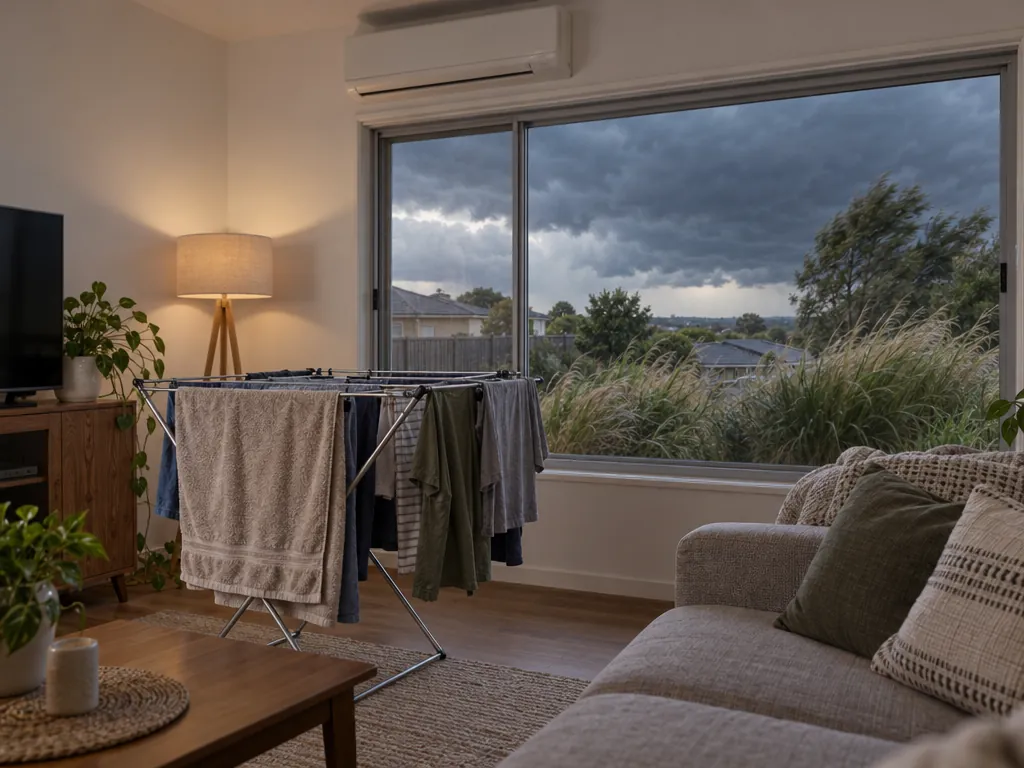
Through the rest of the pollen season, the Council suggests you:
- keep windows closed
- avoid drying laundry on an outdoor line on high or extreme pollen days
- shower and wash clothes exposed to the elements when you arrive home
If symptoms carry on indoors, an air purifier may help.
Have a plan for the worst case. Murrumbidgee Local Health District runs a text alert service for its own region, not the Hunter, and calls these events “rare and hard to predict”. Its advice travels well: identify someone who can drive you to hospital, as ambulance demand can be high.
A shut house is not the whole answer, because closing everything up also shuts in pollen, dust, pet dander and cooking fumes. Speaking to Nine about homes sealed against this spring's Bogong moths, Asthma Australia's Nigel Cooper recommended damp dusting, frequent vacuuming, running the range hood and a HEPA purifier, and warned against insecticides. Shut up for the storm, then keep the inside air clean.
What carpets and rugs can do, and what they can't
| What carpet and rug care can do | What it can't do |
|---|---|
| Vacuum carpets and soft furnishings weekly, with a HEPA vacuum if possibleNational Asthma Council, dust mites | No vacuum cleaner, dust mite spray or dry cleaning process completely removes house dust mitesASCIA, allergen minimisation |
| Lower indoor humidity, and regularly clean blinds and curtainsNational Asthma Council, dust mites | Dry cleaning is not as effective as hot washing: it kills dust mites but won't remove the allergen (stated for bedding)National Asthma Council, dust mites |
| Replace the storm-day steps of staying in, windows shut and air conditioner on recirculateNational Asthma Council, thunderstorm asthma | |
| Replacing carpets with hard floors, where practical and affordable, is another option.ASCIA, allergen minimisation | |
Here is where a carpet cleaner should be most careful with words.
Dust mites live in beds, carpets and upholstered furniture. Their allergens are stirred up by vacuuming, dusting and playing on the floor. The health-body advice is to vacuum carpets and soft furnishings weekly, with a HEPA vacuum if possible.
At Harbourfresh Carpet Cleaning we'd put it plainly. A deep clean is one part of a household plan for dust. It is not a treatment for asthma or hay fever, and it is not protection on a storm day.
Vacuuming with an allergic person in the house
- Allergic person leaves the room
- Someone else vacuums (HEPA if possible)
How you vacuum matters as much as how often. Even with a HEPA vacuum, vacuuming raises airborne dust-mite allergen for up to 20 minutes. So the Council suggests you ask someone else to vacuum while the allergic person is out of the room.
The other levers are worth knowing:
- Wash bedding hotter than 60°C.
- Dry cleaning is not as effective as a hot wash: it kills dust mites but "won't remove the allergen", a point the Council makes about bedding.
- Reduce indoor humidity and clean blinds and curtains regularly.
Carpet care is one lever among several.
Why damp coastal homes and wet carpet matter here
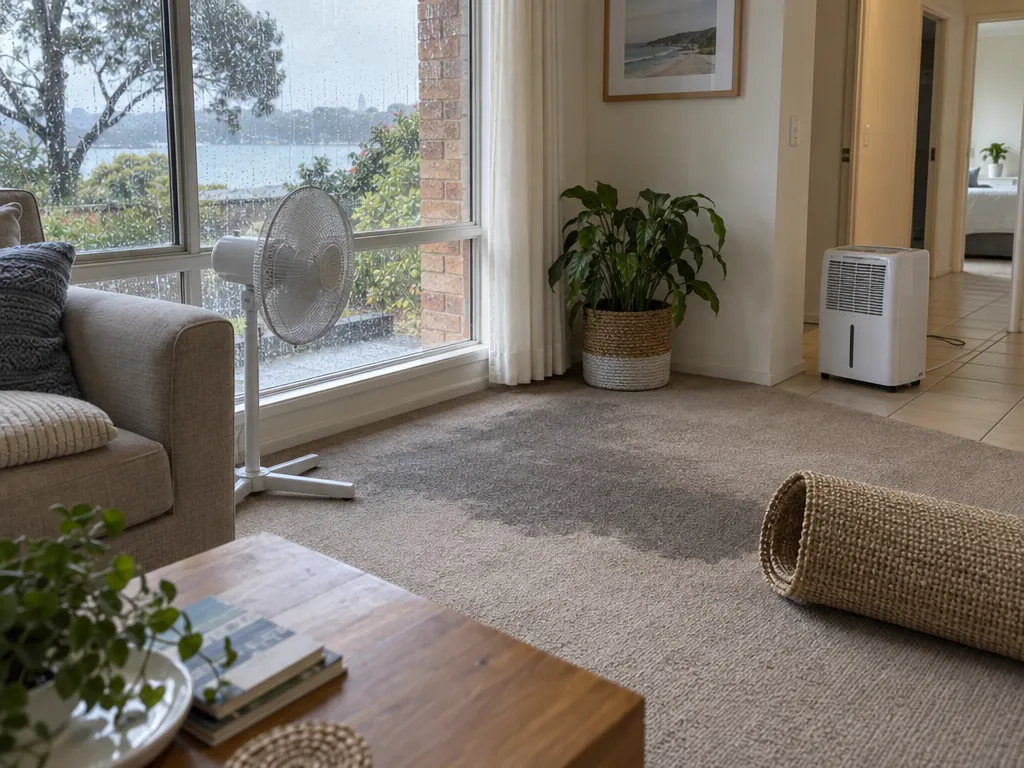
Damp matters because dust mites thrive in warm and humid environments, and the Council's list of levers includes reducing indoor humidity.
Spring storms are also when roofs and windows leak. If your carpet gets wet, start with our guide to the first 48 hours of water damage in carpet. For a roof or window leak, our storm leak guide covers who to call and what to photograph. If you can already see growth, read mould on carpet: when to stop cleaning.
Spring at home, at a glance
Grass pollen season: start of October to end of December
National Asthma Council, ten years onStorm day: stay in, windows shut, air conditioner on recirculate, evaporative systems off (may not completely prevent exposure)
National Asthma Council, thunderstorm asthmaAustralian Asthma HandbookVacuum carpets and soft furnishings weekly, HEPA if possible
National Asthma Council, dust mitesDust-mite allergen stays raised for up to 20 minutes after vacuuming
National Asthma Council, dust mitesWash bedding hotter than 60°C
National Asthma Council, dust mitesAbout 1 in 5 have allergic rhinitis; up to 4 out of 5 people with asthma also have allergies such as hay fever
National Asthma Council, pollen and hay fever
Two different jobs, side by side. On a storm day, keep the outside air out. Through the year, keep the dust down.
Your next step with Harbourfresh
Start with the things only you and your GP can do: update the action plan and know your storm-day routine.
If your carpets, rugs or upholstery are due for a deep clean as part of a year-round plan for dust, Harbourfresh Carpet Cleaning works across Newcastle, Lake Macquarie and the Hunter. Tell us about your home through our free quote form. To work out how often is sensible, our guide to how often to clean carpets is a good place to begin.
Sources
- https://www.nationalasthma.org.au/news/ten-years-since-catastrophic-thunderstorm-asthma-event
- https://www.nationalasthma.org.au/resources/thunderstorm-asthma
- https://www.asthmahandbook.org.au/clinical-topics/thunderstorm-asthma
- https://www.nationalasthma.org.au/news/time-to-prepare-for-thunderstorm-asthma
- https://www.safework.nsw.gov.au/resource-library/heat-and-environment/thunderstorm-asthma
- https://www.allergy.org.au/patients/allergic-rhinitis-hay-fever-and-sinusitis/pollen-allergy
- https://www.allergy.org.au/patients/allergy-treatments/allergen-minimisation
- https://www.newcastleherald.com.au/story/5744418/thunderstorm-asthma-warning-for-hunter-region/
- https://nctimes.com.au/2026/10/16/storm-hotspots-keep-moving-across-nsw
- https://www.nationalasthma.org.au/resources/pollen-and-hay-fever
- https://www.nsw.gov.au/departments-and-agencies/mlhd/news/latest-news/thunderstorm-asthma-alerts
- https://www.nine.com.au/lifestyle/why-is-hayfever-so-bad-this-spring-factors-bogong-moth-migration-20261024-p617tg.html
- https://www.nationalasthma.org.au/resources/dust-mites-trigger-my-asthma-and-allergies