On a smoky day, an evaporative cooler can swap all the air in your house for outdoor air 20 to 30 times an hour. A HEPA purifier sized to the Victorian Government's minimum cleans one room's air about five times an hour.
Both numbers are our estimate, worked from two sources. The Better Health Channel says evaporative coolers "can completely replace the air in the house every 2 to 3 minutes". Sixty minutes divided by 3 is 20, and divided by 2 is 30. The Victorian Government's guide to choosing an air purifier asks for at least 108 cubic metres an hour of clean air in a 3 m x 3 m room with a 2.4 m ceiling. That room holds 9 x 2.4 = 21.6 cubic metres, and 108 divided by 21.6 is 5. Every room size in its table works out at the same five.
Put side by side, the cooler brings in outside air four to six times as often as the purifier cleans the air (our estimate: 20 or 30 divided by 5). That is why NSW Health says not to use evaporative coolers at all. On a smoky day, the first decision is what to switch off. What to buy comes second.
Smoke is a real prospect this season. AFAC's Seasonal Bushfire Outlook Spring 2026 puts northern and south-eastern NSW at heightened fire risk, with "below average rainfall" among the drivers. The Bush Fire Danger Period runs 1 October to 31 March, and permits are required in Newcastle, Lake Macquarie, Maitland, Cessnock and Port Stephens. The Hunter has seen heavy smoke recently, too. The Newcastle Herald reported heavy smoke over Newcastle and the Hunter coast on 31 January and 1 February 2026, from the Nerong and Oyster Cove fires in Port Stephens.
Staying inside is only half the answer. The Australian Centre for Disease Control warns that smoke "can reach dangerous levels even inside buildings, especially when it lingers in an area for a long time". Here is the order Harbourfresh Carpet Cleaning suggests for keeping it out, drawn from NSW Health, the CDC and the state health departments.
Seal, recirculate, filter, flush: the order for a smoky day
Seal, recirculate, filter, flush
Source: NSW Health, Australian Centre for Disease Control
There are four steps, and they work best in this order.
- Seal. Close windows and doors, says NSW Health. Then seal the gaps with tape or damp towels, as the CDC suggests.
- Recirculate. Run a split system, or switch other types to recirculate if you can (CDC). Leave any evaporative cooler off.
- Filter. Use a HEPA air purifier in a small, well-sealed room (NSW Health).
- Flush. Open up when air quality improves (NSW Health), "even if the smoke clears only for a short time" (CDC).
Skip step one and the other three are working against an open door.
Can I use my air conditioner when it's smoky?
| Air conditioner type | Safe to run in smoke? | Condition or reason |
|---|---|---|
| Split system (including central ducted) | Yes | External doors and windows closed. |
| Window or wall unit | Yes, with a condition | Outdoor-air vent closed. |
| Cassette unit | Yes, with a condition | "Fresh air" setting off. |
| Two-hose portable refrigerated | Yes | |
| Single-hose portable refrigerated | No | Creates negative pressure and pulls air in through gaps. |
| Central evaporative cooler | No | Can replace the air in the house every 2 to 3 minutes. |
| Portable evaporative unit | Only recirculates indoor air if doors and windows are sealed | NSW Health says do not use evaporative coolers. |
It depends on the type. NSW Health says to switch the air conditioner to recirculate if it has that function, and not to use evaporative coolers, because they bring outdoor air inside.
Not every air conditioner is safe to run in smoke: Victoria's Better Health Channel rules out single-hose portable units and central evaporative coolers.
The single-hose portable is the one that catches people out. It looks like a sealed box on wheels. But it pushes air out through its one hose, which creates negative pressure, and the house then pulls air in through the gaps to make up the difference. A two-hose unit avoids that and is fine to use.
The other types come down to a single setting:
- Split systems, including central ducted, are fine with external doors and windows closed.
- Window and wall units are fine only with the outdoor-air vent closed.
- Cassette units need "fresh air" turned off.
All three come from the Better Health Channel, which is Victorian guidance. In NSW, follow NSW Health's simpler rule: recirculate, and no evaporative coolers.
How to seal up, and why one small room matters
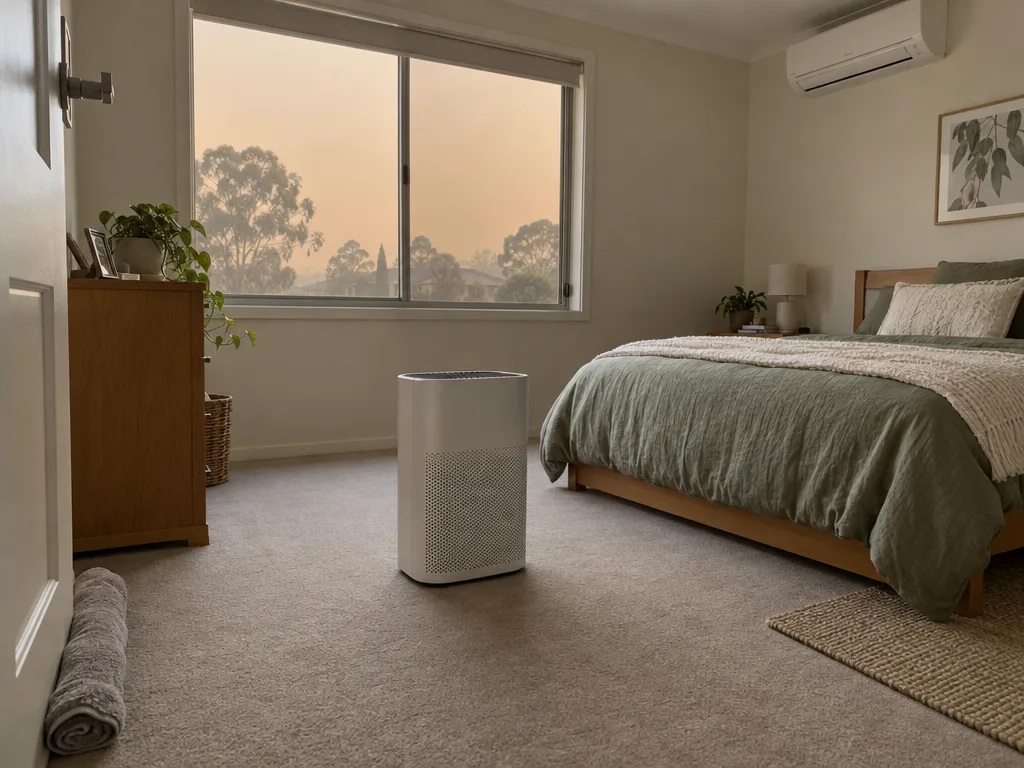
Shut every external window and door first. Then deal with the gaps. Under doors, around old window frames and at the edges of sliding doors, the CDC suggests tape or damp towels.
Older houses leak more, and that matters for everything that follows. Reporting on an Australian controlled-burn study, ABC Science notes that "leaky" older homes reduce what a purifier can do.
That is the case for a clean-air room. NSW Health says a HEPA purifier works well only in small, well-sealed areas, which is why we suggest one room, not the whole house. A bedroom with one window and one door is easier to seal than an open-plan living area. The Victorian Government adds: keep the unit away from open doors and windows.
If the house gets too hot, or keeps letting outside air in, Queensland Health suggests an air-conditioned break at a library or shopping centre.
Drying a wet floor while you're sealed up? Our water damage guide talks about opening up to dry, which is the opposite of smoke advice. While smoke keeps the windows shut, the other drying options SafeWork NSW lists, dehumidifiers and air conditioners on dry mode, are the ones to lean on.
What an air purifier for bushfire smoke can and can't do
Share of PM2.5 removed by portable purifiers, as studies found
Studies found these ranges; leaky older homes reduce the effect. Not a promised result.
Source: ABC
A good purifier helps. It does not make a smoky house smoke-free.
ABC Science reports what studies found:
- A global review found portable purifiers removed 54 to 92 per cent of PM2.5, the fine particles in smoke.
- An Australian controlled-burn study found HEPA purifiers removed 30 to 74 per cent.
The lower Australian range is the more useful guide for an older Hunter home. Neither range is a promise for your room.
What makes a purifier worth running:
- A true HEPA filter. It must trap at least 99.95 per cent (European standard) or 99.97 per cent (US standard) of particles down to 0.3 microns, according to Choice.
- A HEPA grade of at least H13, sized by CADR for the room, per the Victorian Government.
- A carbon or charcoal filter, which ABC Science says can help with the gases and odours in smoke.
What to skip:
- Units with ionic, ionisation or ozone features (ABC Science).
- Ionisers, plasma, ozone and UV purifiers (Victorian Government).
- Humidifiers, negative ion generators and odour absorbers. NSW Health says none of them remove fine smoke particles.
What it costs to keep running: ABC Science reports, citing Choice, that replacement filters can cost more than $200 a year (checked October 2026).
What it won't touch: a purifier "will have no effect on dust on floors or furniture", says Choice. Floors and soft furnishings still need regular cleaning.
How big a purifier does your room need?
Minimum clean air delivery rate (CADR) by room size, in cubic metres per hour
Source: Victorian Government
Size matters more than features. The CDC says to "always make sure it's the right size for the room".
The measure to look for is CADR, the clean air delivery rate, in cubic metres an hour. The Victorian Government sets these minimums for a 2.4 m ceiling and up to five people:
- 3 m x 3 m (9 m²): 108
- 4 m x 4 m (16 m²): 192
- 5 m x 5 m (25 m²): 300
- 6 m x 6 m (36 m²): 432
For a room between those sizes, our estimate is floor area x 2.4 x 5. That is the same five room-changes an hour the table works out to. A 12 m² bedroom comes to 144 cubic metres an hour. Check your figure against the Victorian guide before you buy.
Then go one step up. Choice suggests choosing a unit rated for a slightly larger room, so it can run quietly on low. A purifier you can sleep beside is one you will actually leave on.
Don't add smoke of your own indoors
While the house is shut
A sealed house holds onto whatever you create inside it. NSW Health says to avoid indoor sources such as cigarettes, vapes, candles and incense.
Queensland Health widens the list. It adds un-flued gas appliances and woodstoves, along with "stirring up fine dust from sweeping or vacuuming".
That last one is worth weighing while the house is shut. With no fresh air coming in, whatever gets kicked up has nowhere to go.
Who needs a plan before the smoke arrives
Ready before smoke
Some people feel smoke sooner and harder. For anyone with asthma, or a heart or lung condition, the plan belongs to them and their doctor. What follows is the government advice to talk through, not medical advice from us.
Medication and plans. The CDC says to have inhalers, medication and asthma action plans ready for anyone who relies on them. Queensland Health says people with heart or lung conditions should keep at least five days' supply of medication.
Masks. Keep P2/N95 masks at home, says the CDC. The details matter:
- Ordinary paper dust masks, handkerchiefs and bandannas do not filter fine particles (Queensland Health).
- P2 masks do filter fine particles, but they do not filter gases such as carbon monoxide (Queensland Health).
- Without a tight seal, a mask "may give you a false sense of security" (ABC Science).
Alerts and air quality. NSW rates air quality in five categories, from Good through Fair, Poor and Very Poor to Extremely Poor, using hourly readings. The same page points to the Hazards Near Me app for alerts.
When to call. For trouble breathing or chest pain, call 000, says the CDC. If you are worried, Healthdirect is on 1800 022 222.
After the smoke clears: flush the house, then wipe the ash
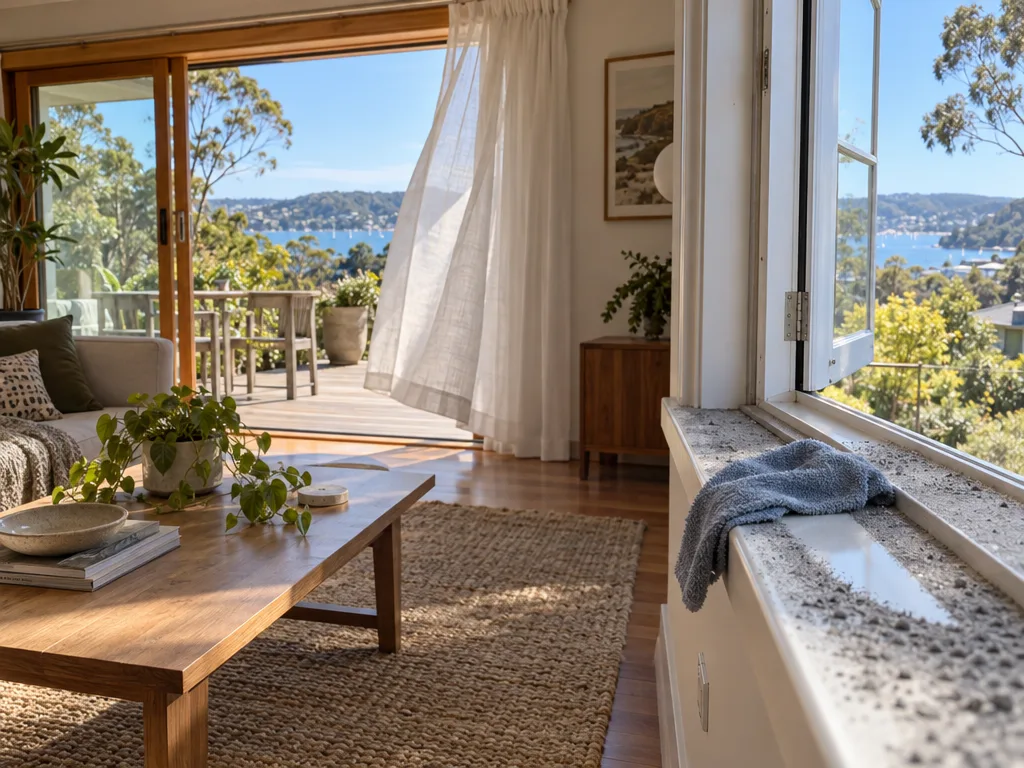
The moment the air improves, open up. The CDC says to open windows and doors "even if the smoke clears only for a short time". NSW Health gives the same timing. The hourly NSW air quality readings tell you when that is.
This step matters most in an older, leaky house. Smoke seeps in over hours and has no way out once the house is shut again. Without sealing and a fresh-air flush, ABC Science warns, indoor air "could end up being worse than outside".
Then clean the surfaces that have collected ash or soot (CDC). Start with windowsills, benches and the floor nearest the doors. The smell that settles into soft furnishings is a separate job from the air, and it usually outlasts the haze.
Smoky day: the numbers to keep
Source: Better Health Channel, Choice, Victorian Government, ABC, Queensland Government
When the house is open again: your next step
A purifier works on the air. Floors and furniture are a different matter: Choice notes that a purifier has no effect on dust on floors or furniture, so floors and soft furnishings still need regular cleaning. That is housekeeping, not a fix for the air. The air is what the steps above are for.
Once the windows are open and the ash is wiped down, Harbourfresh Carpet Cleaning cleans carpets, rugs and upholstery across Newcastle, Lake Macquarie and the Hunter. If you are working out timing, our guide to how often to clean carpets is a good place to start.
When you are ready, tell us about your rooms and ask for a quote through our free quote form.
Sources
- https://www.health.nsw.gov.au/environment/bushfire/Pages/bushfire-protection.aspx
- https://www.cdc.gov.au/advice/staying-safe-bushfire-smoke
- https://www.betterhealth.vic.gov.au/using-air-conditioners-when-its-smoky-outside
- https://www.vic.gov.au/choosing-an-air-purifier
- https://www.abc.net.au/news/science/2025-08-03/air-purifier-cleaner-hepa-filter-smoke-wood-heater-bushfires/105503734
- https://www.choice.com.au/home-and-living/cooling/air-purifiers/articles/air-purifiers-and-asthma
- https://www.qld.gov.au/health/staying-healthy/environmental/after-a-disaster/bushfires/bushfire-smoke-and-your-health
- https://www.nsw.gov.au/environment-land-and-water/air-quality
- https://afac.com.au/public-resources/seasonal-bushfire-outlook-spring-2026
- https://www.rfs.nsw.gov.au/fire-information/BFDP
- https://www.newcastleherald.com.au/story/9165069/heavy-smoke-from-port-stephens-bushfires-impact-hunter-region/
- https://www.safework.nsw.gov.au/hazards-a-z/mould
Pictures in this guide are illustrations, not photos of our jobs.