Moving out in NSW: carpet wear and tear, damage and the pet clause
In NSW the carpet test at moving-out time is how it compares with the day you moved in, not whether you hired a cleaner, so knowing where wear and tear ends and damage begins is what protects your bond.
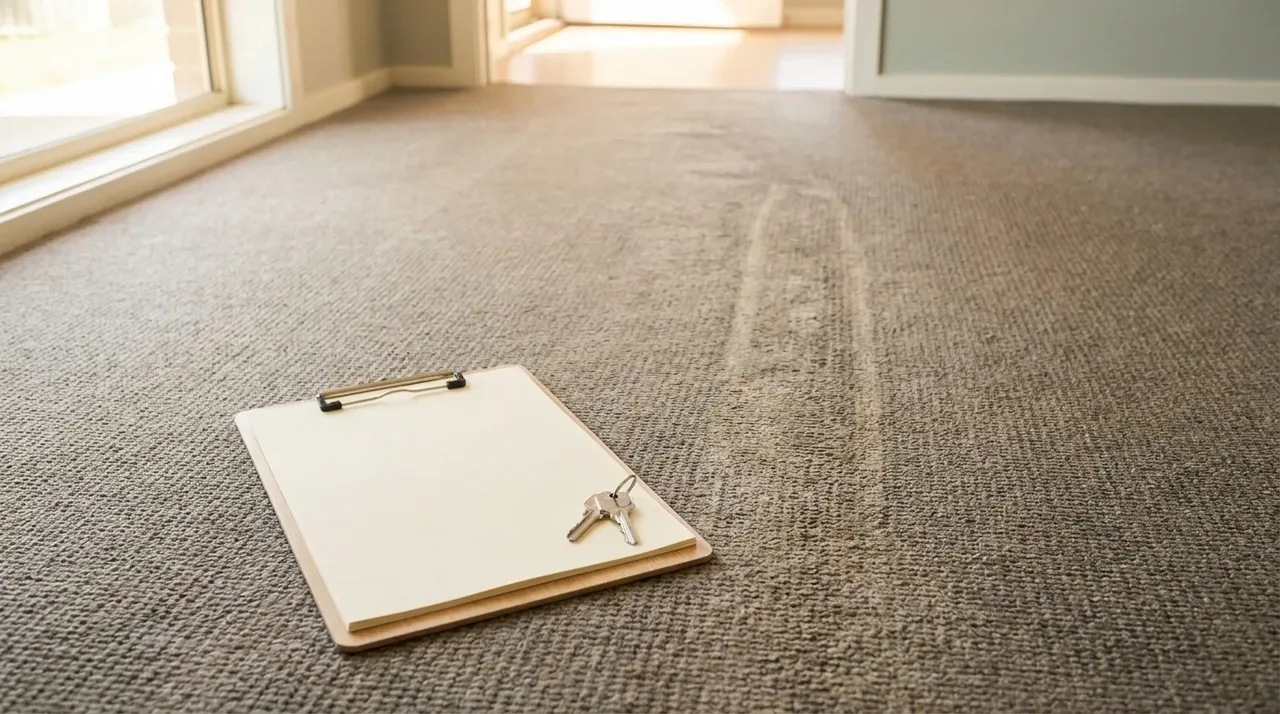
Illustration. A condition report and house keys on a worn lounge-room carpet.
In NSW, moving out does not automatically mean paying for a
professional carpet clean. The rule is that you leave the place in
about the condition it was in when you moved in. You repair, or pay to
repair, damage beyond reasonable wear and tear. So the questions that
decide your bond are simple. What did the carpet look like on day one?
Is what has changed since then wear, or damage?
There is one exception, and it involves pets. It only applies when
three conditions are all met.
Do you have to get the carpets professionally cleaned when you move out?
Not as a blanket rule. NSW Fair Trading's guidance on moving out of a
rental home
says a tenant must leave the property in a similar condition to
move-in. It also says the tenant must repair, or pay the cost of
repairing, any damage that is not reasonable wear and tear.
That test is about condition, measured against the start of the
tenancy. It says nothing about who did the cleaning. A lease clause or
an agent's checklist that says "carpets professionally cleaned" is
worth reading against that standard, and against the pet rule further
down.
What counts as wear and tear on carpet, and what counts as damage
Fair wear and tear
Damage
Furniture indentations
Stains
Traffic marks
Burn marks
Water stains from rain through a leaking roof or bad plumbing
Water stains from an overflowing bath or indoor pot plants
Fair wear and tear: furniture indentations and traffic marks.
Damage: stains or burn marks.
Water stains: from rain through a leaking roof or bad plumbing
is fair wear and tear. From an overflowing bath or indoor pot plants
is damage.
This is the line a carpet argument at the end of a lease is decided
on. A worn path from the front door to the kitchen is what years of
living does to carpet. The dents where the couch stood are the same. A
red wine stain by the coffee table is different. So is a scorch from a
heater that sat too close. Those are marks that something happened.
Illustration. A worn walkway and couch dents on one side of the room, a drink stain and a heater scorch on the other.
The practical upshot: don't lose sleep over traffic lanes. Put your
attention on anything that looks like a spill, a spot or a burn and
wasn't there when you moved in.
Why the condition report decides a carpet dispute
Your memory of the carpet on move-in day counts for little in a
dispute. The paperwork counts for a great deal. According to NSW Fair
Trading's page on rental property condition
reports,
the condition report is the evidence of how the property looked before
the tenant moved in. It is filled in at both the start and the end of
a tenancy, and it is what a carpet dispute is measured against.
If the entry report already noted a stain in the hallway, that stain
isn't yours to fix. If the entry report says "carpet clean, no marks"
and there's a burn by the heater now, the report makes that plain to
everyone.
The same page says the more detail in the report, including
time-stamped photographs, the less likely a dispute at the end, and
that tenants should take photos with time
stamps
to go with the report and return their completed copy to the landlord
or agent within seven days of moving in.
Check the carpet against the entry report before moving day
The costly version of this is reading the entry report after the exit
inspection, when the argument has already started. Read it the week
before instead. That gives you time to act on anything that falls on
the damage side of the line.
Find your copy of the entry report and the photos you took with it.
Walk each carpeted room against it.
Note anything that looks like a spill, a spot or a burn and isn't on
the report.
If you have a pet, find the landlord's response to your pet application.
Before moving day
A stain you find yourself, with a week to spare, gives you options.
The same stain listed on the exit report gives you fewer.
When a pet clause can require a professional clean
This is the rule that decides whether a pet clause can be enforced.
According to NSW Fair Trading's page on pets in
rentals,
a landlord can only require you to professionally clean the carpets at
the end of a tenancy because of a pet if all three of these are true:
All three must be true
If any box stays empty, the pet rule doesn't require a professional clean.
Source: NSW Fair Trading
The requirement was given as a condition of consent in the
landlord's response on the pet application form.
It was appropriate for the animal and the property. Fair Trading's
own example is that keeping a goldfish should not require a
professional carpet clean.
The pet was kept indoors.
If all three are true, the clean must be carried out regardless of
the state of the
carpets,
and the condition still applies if the pet no longer lives there, for
example because it has died. If any of the three is missing, the
condition doesn't apply. The general moving-out standard still applies
either way: Fair Trading says a landlord can ask you to fix carpet
staining that isn't fair wear and tear even if the damage was not
caused by the pet.
A pet stain that wasn't on the entry report is still a stain.
Find the landlord's response to your pet application now, while you
can still check the wording. If you're still mid-lease with a pet, our
guide to keeping carpets fresh with
pets
covers the day-to-day side.
Who holds your bond, and how it comes back
Your bond isn't sitting in the landlord's account. In NSW it is capped
at no more than 4 weeks'
rent.
It is lodged through Rental Bonds Online, and it is NSW Fair Trading
that pays it back, not the landlord.
The path a bond takes
1
Claim the bond through Rental Bonds Online.
2
The landlord or agent has 14 days to accept or dispute the claim.
3
Accepted: paid two business days after acceptance.
4
Disputed: the landlord or agent applies to NCAT.
Source: NSW Fair Trading
To get it back, you claim it through Rental Bonds Online, as set out
on the page about getting your bond
back.
Your landlord or agent has up to 14 days to accept the claim, and if
your details are correct the money should be in your account two
business days after the claim is
accepted.
The paper Claim for Bond Refund form is only for a bond that isn't in
Rental Bonds Online.
What happens if the landlord disputes the claim
You don't need to wait for the landlord to release the bond. Once the
tenancy is over you can claim it yourself, and the landlord or agent
has 14 days to dispute the
claim.
If they don't, Fair Trading pays it after those 14 days.
Fair Trading's list of grounds for a claim on the bond includes not
cleaning the property to the same standard as the start of the
tenancy
and damage beyond fair wear and tear. Both are measured against the
start of the tenancy. A landlord or agent who claims part of your bond
without your agreement must give you a copy of the end-of-tenancy
condition report and copies of estimates, quotes, invoices or receipts
for the work within 7 days of making the
claim.
A carpet clean they want you to pay for has to show up in that
paperwork.
"The Tribunal is set up to hear both sides of the story about tenancy disputes. This includes disagreements about bond refunds."
None of this is arbitrary. There is a claim, a deadline and a tribunal
at the end of it. Whoever turns up with the clearest evidence is in
the stronger position. On carpet, that evidence is the entry report,
the exit report and your time-stamped photos.
Where a carpet clean fits in your move-out
At Harbourfresh Carpet Cleaning, our view is simple. Clean because the
carpet needs it, not because you assume the law demands it.
Traffic marks and furniture dents sit on the wear-and-tear side of the
line, so there's nothing to fix. A stain that wasn't on the entry
report is different, and so is a valid pet clause. Those are the cases
where a clean earns its place. Deal with either early enough that
you're not arranging it the night before the keys go back.
If that's you, and you're moving out anywhere in Newcastle, Lake
Macquarie or the Hunter, tell us about the carpet, rugs or upholstery
through our free quote
form. For the
cleaning side of moving out, see our guide to end-of-lease carpet
cleaning.
To see what we clean, visit our services
page.